

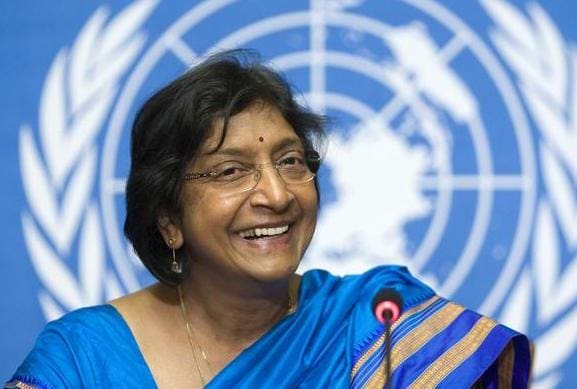
A legal career that began with defending anti-apartheid activists has taken South African jurist Navanethem “Navi” Pillay to the highest levels of international justice.
Pillay was awarded the 2026 Nobel Peace Prize on Friday, 9 October, for her efforts to promote peace and international law.
The Norwegian Nobel Committee recognised her contribution to developing a global legal system in which perpetrators of war crimes, crimes against humanity and genocide can be held accountable.
Born in Clairwood, Durban, on 23 September 1941, Pillay grew up under apartheid and faced racial and gender discrimination in the legal profession.
In 1967, she became the first Black woman to establish her own law practice in Natal, now KwaZulu-Natal. She represented political activists detained by the apartheid government and challenged abuses against prisoners, including torture and solitary confinement.
Following the end of apartheid, Pillay was appointed an acting judge of South Africa’s High Court in 1995. That same year, she joined the International Criminal Tribunal for Rwanda, where she served as a judge for eight years, including four years as president.
One of her most significant contributions came during the trial of Jean-Paul Akayesu. The landmark case established that rape and sexual violence could constitute acts of genocide under international law.
Pillay later served as a judge at the International Criminal Court before becoming the United Nations High Commissioner for Human Rights in 2008. She held the position until 2014, advocating for human rights and accountability around the world.
Her work has continued to attract international attention. In 2025, a UN commission of inquiry chaired by Pillay concluded that Israel had committed genocide in Gaza. Israel rejected the commission’s findings.
The Nobel Peace Prize announcement comes as international legal institutions face mounting challenges over their authority and ability to hold powerful individuals and states accountable.
Pillay’s recognition places a South African legal pioneer at the centre of renewed international attention on the role of law in preventing atrocities and protecting human rights.
Her career spans the struggle against apartheid, landmark international criminal cases and senior roles within the United Nations, reflecting decades of work on justice and the rule of law.


