


In a country where less than half of Grade 4 learners can read for meaning, educators in Orange Farm and Lenasia South are demonstrating the power of community initiatives to close the gaps.
In the heart of Orange Farm Ext 1, a group of preschoolers sit cross-legged around a sandpit, tracing letters in the dust. “B + A + L + L = ball,” chants their educator, Dimakatso Mbele in English. She then repeats the exercise in isiZulu and Sesotho.
Mbele is a founder of Tshebedisano Daycare and Pre-School, a Department of Basic Education (DBE) accredited centre, which charges R350 per month per child.
Mbele says: “We teach in English and translate in both Zulu and Sotho to balance understanding. Before we teach the children to write their names, we teach them to spell them – in all three languages.”
Mbele believes that literacy begins where children feel most at home – in their own languages. Her approach aligns with a central premise of South Africa’s Funda Uphumelele National Survey (FUNS), which was released by the DBE last week: that home languages are an asset, not a barrier, and that strong skill transfer occurs between home-language literacy and English Additional Language tasks.
The FUNS benchmarks also confirmed what teachers like Mbele and other township classrooms have long known: most learners cannot read at the pace required for later schooling, with only 46% of Grade 4 learners nationally able to read for meaning across all home languages.
Tshebedisano, with 57 children and five staff, blends the DBE curriculum with phonics, play, and cultural familiarity. Learners spell words in a sand-writing area, sing vowel-of-the-week songs, and have daily quiet reading sessions.
Mbele says many can decode words in English and their mother tongues before Grade 1, signalling a local success that addresses one of South Africa’s deepest education challenges.
A few kilometres away, Agnes Ramosela, principal of DBE registered Tshepiso’s Kiddies World and Tshepiso ya Lerato Preschools in Lenasia South Extension 4, has chosen a different path, adopting an English medium of instruction to best accommodate hundreds of learners from diverse home language backgrounds. “Children come from homes where isiZulu or seSotho are spoken. It’s difficult at first, we translate constantly. But after six months, they begin to understand, and by year-end they’re confident in English.”
Ramosela’s response stems from a pragmatic belief that early exposure to English equips children to succeed later, as most formal schooling in South Africa is English-medium. Parents in her community tend to agree – enrolling their children precisely for that reason. Her approach mirrors widespread parental sentiment: that English is the language of opportunity, even if comprehension comes at the cost of connection.
Both schools represent different answers to the same question: how do we help children read against all odds?
FUNS shows how early decoding skills develop and how few learners meet the benchmarks required to read with comprehension by Grade 4. According to the report, only 31% of Grade 1 learners meet the Home Language benchmark of 40 correct letter sounds per minute; in Grades 2 and 3, just 33% and 31% respectively reached their language-specific oral reading fluency benchmarks. By the end of Grade 3, 15% of learners cannot read a single word, a stark indicator of the scale of the decoding challenge rather than a reflection of the natural Words-Per-Minute (WPM) differences between languages. These language-specific benchmarks vary because languages belong to different orthographic families, each with its own reading progression patterns.
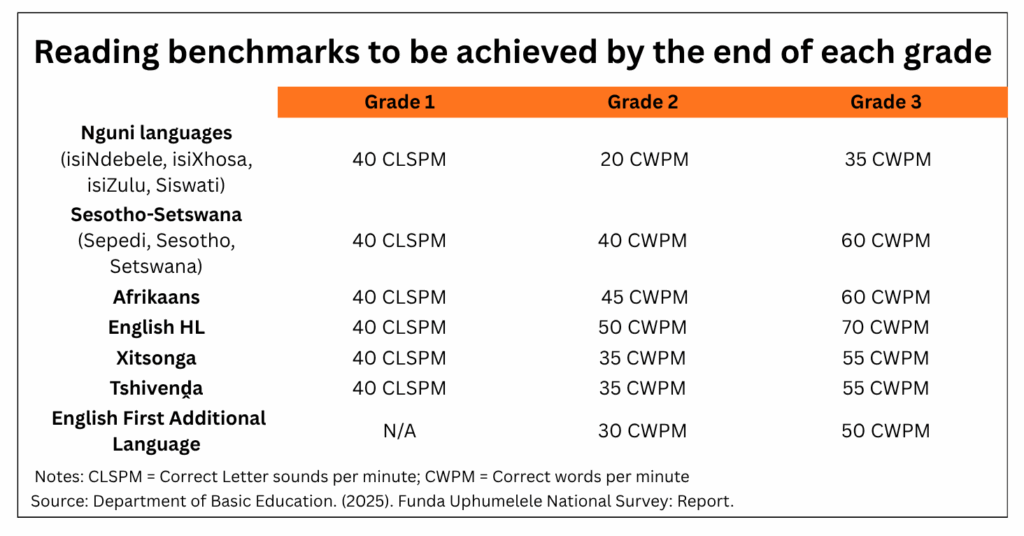
This evidence underscores what both Orange Farm and Lenasia South Pre-schools are trying to overcome. As DBE’s Director of Reading. Dr Nompumelelo Nyathi-Mohohlwane explains: “Until learners cross the decoding threshold, comprehension cannot develop.”
Professor Emeritus in the Department of Linguistics and Modern Languages at UNISA, Elizabeth Pretorius, added: “It is strong decoding skills – in any language – that free up working memory, making space for meaning-making.” Their research shows that early exposure to a familiar language supports the development of these foundational skills, but it is the quality of decoding instruction that ultimately determines reading success. Their research highlights that while early exposure to a familiar language helps lay the foundation for learning, effective, well-structured decoding instruction and consistent monitoring are what truly drive literacy progress.
At Tshebedisano, quality comes through practice. Teachers train with Grow ECD every month, adapt lessons using games and storytelling, and invite parents to observe sessions. Children are encouraged to write in sand before pencil, blending tactile memory with sound recognition. The evidence of success lies in how smoothly graduates transition to primary school.

“Zonkiziwe Primary School in Orange Farm Ext 1 has even requested support from our staff after noticing how well our learners perform,” says Mbele.
At Tshepiso’s Kiddies World, where learners start out with no English, most children achieve conversational fluency within months. Learners’ workbooks are routinely submitted to the Department for review, and both centres maintain full enrolment every year, clear signals of community trust in their model.
Together, these stories reveal insights into the literacy crisis, ones echoed by FUNS.
First: Language is not the enemy of progress; misunderstanding is. Home languages, when used well, accelerate foundational reading skills.
Second: Teacher skill and support are more crucial than policy alone. FUNS shows that prepared, well-supported teachers drive progress far more than policy intentions alone.
Third: Community and context matter as much as curriculum. FUNS highlights deep inequalities across languages, provinces, and socio-economic groups, underscoring how environments shape literacy journeys as strongly as classroom practice.
Pretorius cautions that mother-tongue instruction alone is not a magic bullet, noting that without well-designed teaching materials, teacher support, and ongoing assessment, even the best policies will fall short – because decoding must be explicitly and effectively taught, regardless of the language of instruction.
This article is the final in a series that has been produced with the support of the Henry Nxumalo Foundation. See Part 1, Part 2, and Part 3 here.