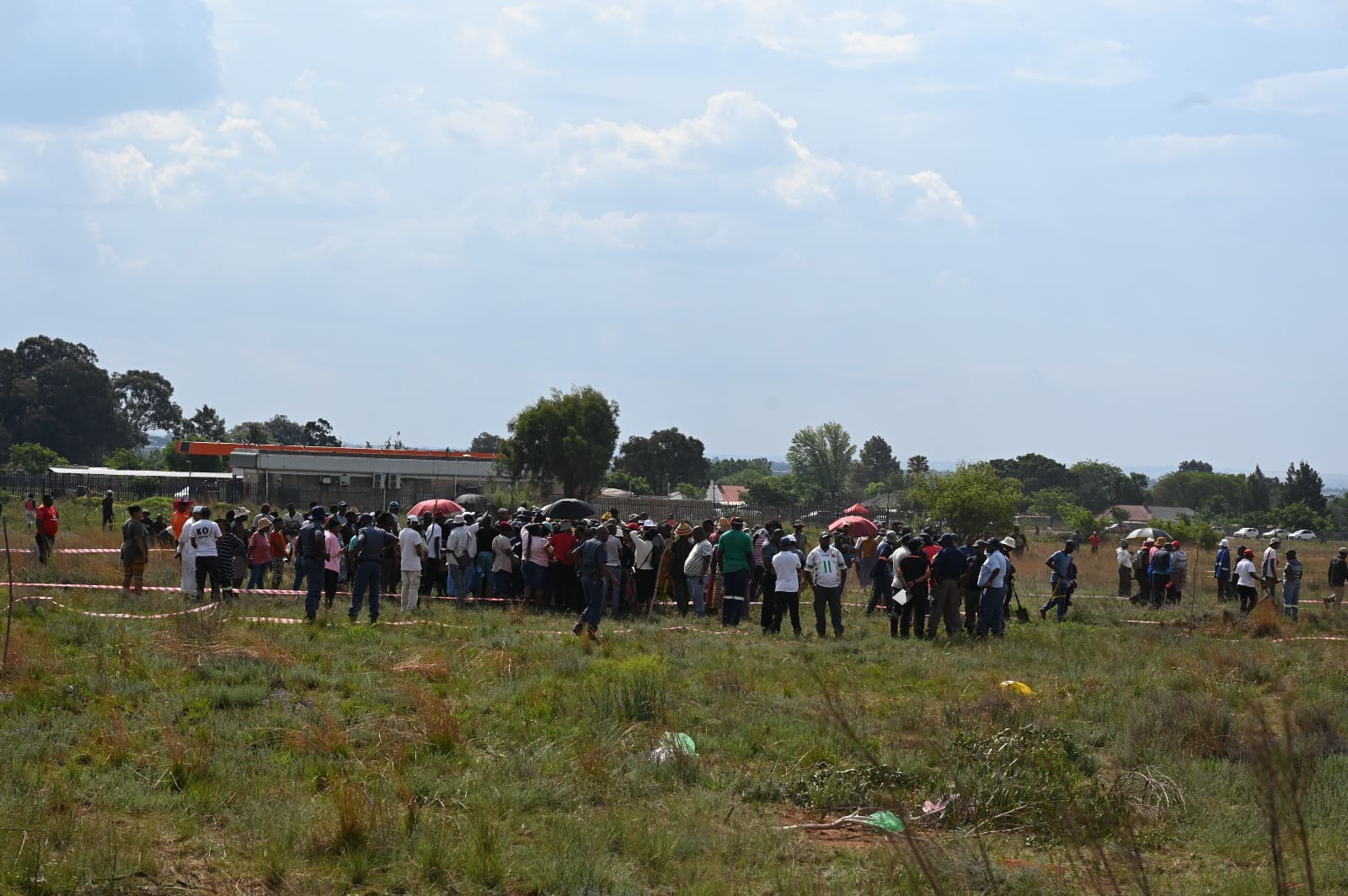
A week-long confrontation over land along the K43 in Lenasia has brought South Africa’s ongoing housing challenges, property rights and concerns over community infrastructure into sharp focus, following a coordinated operation to clear an alleged illegal occupation.
What began as groups of people arriving at an open piece of land quickly developed into a dispute involving the property owner, law enforcement agencies and community representatives, as questions emerged about who had the right to occupy the property. Globe Post has been following developments throughout the week, documenting growing concerns as individuals reportedly attempted to claim portions of land without formal authorisation.
According to information gathered by GLOBE POST, some residents in the surrounding area had previously been legitimately allocated stands and provided with electricity connections. The presence of these established households appears to have encouraged others to believe that additional land was available for occupation. However, the disputed property was subsequently identified as privately owned, raising concerns about the circulation of information suggesting that the land was available free of charge. The landowner has reportedly spent much of the week attempting to prevent further occupation, while the authorities worked through the necessary legal procedures.
The Johannesburg Metropolitan Police Department (JMPD) was aware of the situation and was active on site along the K43 near Lenasia. JMPD officers were cassisting the City’s Department of Human Settlements, which is leading Phase 1 of a structured two-phase operation: Phase 1 (Verification & Auditing): Human Settlements is actively conducting a verification process to audit the existing informal settlement at Roodepoort Farm and Lensia. While this auditing phase is underway—and despite ongoing attempts by trespassers to peg new land—the area is being strictly monitored.

Omar Khan, Ward 120 councillor candidate for the Truth and Solidarity Movement, who was present during developments at the site, told Globe Post that people arrived using various forms of transport, including e-hailing services, taxis and private vehicles. Khan said he spoke to approximately 10 to 15 individuals to establish whether they had paid for the land or received permission to occupy it. “So nobody said that they paid anything,” he said. According to Khan, those he questioned believed the land was available free of charge and that they could move onto the property and begin building.
The uncertainty surrounding ownership further complicated the situation. Some individuals reportedly believed the land belonged to the City of Johannesburg, while others were unsure whether it was municipal or private property. Khan said he subsequently obtained information through the government’s Geographic Information System (GIS), which he used to establish property details and boundaries. “Once we got the GIS, we found out it is private land,” he explained. The information was then supplied to the police as efforts continued to establish the legal status of the property.
According to Khan, the landowner had already been informed about the attempted occupation and had begun pursuing legal remedies.Two trespassing cases were reportedly opened, while steps were taken to obtain the necessary legal authorisation to address the situation.The process took time, as law enforcement officers were required to follow established procedures before taking action. Khan stressed that residents should understand that police officers cannot simply remove people from a property without the appropriate legal authority. “Report to the relevant departments and then let the police do their job,” he said.
He explained that officers must act according to the law and instructions received through the relevant channels. The dispute highlights the difficult balance between protecting private property and ensuring that people facing housing insecurity are treated lawfully and fairly. Following days of uncertainty, a coordinated operation involving the South African Police Service and Johannesburg Metropolitan Police Department reportedly resulted in the clearing of the disputed property.

According to Khan, the operation was completed at approximately 10:30 in the morning. He said materials brought onto the land were burned during the operation, although the circumstances surrounding the burning have not been independently established.Khan also revealed that additional portions of land had been demarcated beyond the areas visible from the main road, suggesting that the attempted occupation extended further into the property. Although the immediate operation had been completed, concerns remained that some individuals could return. Khan indicated that a limited police presence was expected to remain in the area to monitor developments following reports that people might attempt to return later that evening. The situation remains under observation.
The events along the K43 cannot be viewed entirely separately from South Africa’s long and complicated history of land dispossession, inequality and housing shortages. Land ownership has been one of the country’s most contentious issues for generations.The 1913 Natives Land Act severely restricted land ownership and occupation by Black South Africans, laying the foundation for decades of dispossession and spatial inequality. Under apartheid, forced removals and racially segregated planning policies displaced communities and restricted where people could live, work and own property. Although South Africa’s democratic government has introduced land reform, restitution and housing programmes since 1994, the legacy of these policies continues to influence settlement patterns and access to affordable housing.
Many households still face challenges in securing formal accommodation, particularly in urban areas where employment opportunities attract people seeking better living conditions. The demand for affordable housing, combined with limited access to serviced land, has contributed to the growth of informal settlements and disputes over vacant or underdeveloped property. However, housing insecurity does not automatically justify the unauthorised occupation of land. The K43 dispute illustrates how uncertainty surrounding ownership, informal promises and the absence of clear information can contribute to conflict between prospective occupants, existing residents and property owners.
Land invasions, often described as unauthorised land occupations, are not a new phenomenon in South Africa. They occur for different reasons, including housing shortages, economic hardship, rapid urbanisation and disputes over land allocation. In some cases, individuals occupy vacant land because they have limited alternatives. In others, allegations emerge that people have been encouraged to occupy property through misleading promises or informal arrangements. Establishing the circumstances behind each occupation is therefore essential. In the K43 case, the individuals questioned by Khan reportedly maintained that they had not paid for the land.
However, questions remain about how information regarding supposedly free land reached them and whether anyone actively encouraged the attempted occupation. There is currently insufficient verified information to establish whether the incident was organised or politically motivated.Beyond the immediate dispute over ownership, the attempted occupation has raised concerns about the potential consequences for neighbouring schools and community infrastructure.
During Globe Post’s interview with Khan, attention was drawn to a nearby Muslim school and the possible effects of unplanned settlement expansion. Schools rely on stable access to essential services, including electricity, water, sanitation, roads and secure learning environments. Where new settlements develop without adequate planning, existing infrastructure may come under additional pressure. Unauthorised electricity connections, for example, can create safety hazards and place strain on local distribution networks.
Inadequate sanitation and water infrastructure may also create public health concerns that affect surrounding households and educational institutions.For learners, disruptions to essential services can interfere with teaching, studying and the daily operation of schools. Access to reliable electricity is particularly important for schools that depend on computers, internet connectivity and other educational technology. Unplanned development may also affect access roads and emergency services if sufficient infrastructure is not provided. These are potential risks rather than confirmed consequences of the K43 incident. No specific damage to the nearby school or its infrastructure has been independently established.

Nevertheless, the situation highlights why land-use planning must consider not only housing needs but also the educational, environmental and infrastructure requirements of the wider community. The discussion also brought attention to the history of Muslim education in Lenasia. Khan reflected on his family’s involvement in efforts to establish educational opportunities for Muslim learners during a period when religious practices faced restrictions in schools. According to Khan, his father challenged restrictions affecting Muslim pupils who wished to attend Friday congregational prayers.
He said these efforts contributed to the establishment of a Muslim school and helped create opportunities for faith-based education. The historical account, which requires further independent verification, highlights the importance that educational institutions hold within the community. Schools are not merely buildings. They represent decades of investment, community organisation and opportunities created for successive generations of learners. Protecting their ability to function is therefore an important consideration when developments take place in surrounding areas.
South African law recognises both property rights and the constitutional protections afforded to people facing eviction.Section 25 of the Constitution protects property rights, while Section 26 recognises the right of access to adequate housing. Section 26 also provides that no person may be evicted from their home or have their home demolished without an order of court made after considering all relevant circumstances. The Prevention of Illegal Eviction from and Unlawful Occupation of Land Act, commonly known as PIE, regulates the eviction of unlawful occupiers in circumstances where the legislation applies.
The legal requirements can differ depending on whether people have established homes on the property or whether authorities are responding to an attempted occupation before residential structures are established. Property owners and law enforcement agencies must therefore follow the applicable legal procedures rather than treating every land dispute in the same way. This helps explain why authorities may not immediately remove people from disputed land, even where ownership has been established. In the K43 matter, the exact legal authority relied upon during the clearing operation has not yet been independently confirmed.
Khan, who is contesting the Ward 120 councillor position under the Truth and Solidarity Movement, maintained that his involvement was driven by a commitment to community service. He explained that he had been involved in local issues long before entering politics and viewed his candidacy as an opportunity to gain access to additional resources and support for residents. “I’m only in politics two months and I feel I can use it as a tool to get what our people need,” Khan told Globe Post.
He added that his community work would continue regardless of the outcome of the election. “And even if I don’t win, I’m still going to carry on,” he said. Khan described his involvement in the K43 matter as part of a broader commitment to addressing issues affecting residents. His account also highlights the importance of cooperation between community members, property owners, elected representatives and law enforcement agencies when disputes arise.Following the clearing operation, residents have been encouraged to remain vigilant and report any renewed attempts to occupy the disputed property. Khan stressed the importance of early reporting so that the relevant authorities can respond before further structures are erected or additional disputes develop.

The events along the K43 serve as a reminder that land disputes involve far more than questions of ownership. They also raise concerns about housing insecurity, public infrastructure, access to education, community stability and the responsibility of authorities to ensure that the law is applied fairly. For families seeking accommodation, the promise of available land may offer hope. For lawful property owners and established communities, unauthorised occupation can create uncertainty and conflict.
Finding sustainable solutions requires transparent land allocation processes, improved access to affordable housing and effective communication between authorities and communities. As the immediate confrontation subsides, important questions remain about who circulated information regarding the availability of land, whether further occupation attempts will follow and how the property will be protected.
Globe Post will continue following developments along the K43 as the community awaits clarity on the future of the disputed land.